
 Happy Tuesday! Dr. Kelly here. Should I get adjusted if I’m going for PT?
Yes.
Physical therapy and chiropractic support very different aspects of your body.
They complement each other.
PT focuses on exercises. Their goal typically is to reduce pain.
Their technique and approach to healing is different than chiropractic.
When you choose to go to a chiropractor, why do you pick a chiropractor?
You choose a chiropractor because of the adjustment.
If you are in pain, you and the chiropractor’s goal is to get you out of pain, but we support your body with the adjustment.
We are the only profession that adjusts.
Physical therapy has its place.
Physical therapists are trained to evaluate how muscles, joints, and movement patterns work together. Their goal is to help patients recover from injury, surgery, or chronic conditions by improving how the body moves.
PT treatment plans are often exercise-based and progressive. Sessions may include therapeutic exercises, stretching, balance training, posture correction, and functional movement training. Modalities such as ultrasound, electrical stimulation, heat, ice, or dry needling may also be used to reduce pain and inflammation. Education is a major component of physical therapy—patients learn how to move safely, strengthen weak areas, and prevent future injury.
Physical therapy is commonly prescribed after surgeries (such as joint replacements), sports injuries, neurological conditions, and work-related injuries. Progress is often measured over weeks to months, with a strong emphasis on patient participation and home exercise programs.
Chiropractic does all that and more.
True health is optimal physical, mental and chemical well-being, not merely the absence of disease or infirmity.
Chiropractic works on the inside out.
Working through affecting the nervous system, messages to the brain, to the joint, bone physically vibrating, affecting the muscle.

Causing input to the nerves, bones and muscles.
I recommend exercises because it is important to strengthen the body.
I break care into 3 phases. Stabilize, Stretch, and strengthen.
In phase I the focus is the adjustment.
The adjustment affects the nervous system. We stabilize the spine.
In phase II the focus is stretching.
Stretching the body with muscle stretches, with traction to the spine. All while continuing to support the body with the adjustment.
In phase III, this is my favorite phase, you are feeling good, but you want longer term foundation.
We strengthen in phase III. We set up a solid foundation to build wellness support.
In Maintenance and Wellness we keep you moving forward. Don’t let you slip back to where you were before you started care.
Chiropractic Care: Optimizing Spinal and Nervous System Health
Chiropractic care centers on the relationship between the spine, nervous system, and overall health.
Chiropractors focus on identifying and correcting joint dysfunctions—often referred to as subluxations—particularly in the spine.
The primary tool used is the chiropractic adjustment, a specific manual technique designed to improve joint mobility, alignment, and nervous system communication.
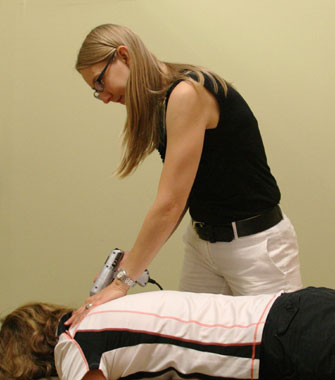
Chiropractic care is frequently sought for back pain, neck pain, headaches, sciatica, and joint discomfort. By restoring proper motion to restricted joints, chiropractic adjustments aim to reduce pain, decrease muscle tension, and support the body’s natural ability to heal.
Many chiropractors also incorporate soft tissue work, corrective exercises, lifestyle counseling, ergonomics, and wellness strategies into care.
Unlike physical therapy, chiropractic care often does not require a medical referral and may be used both for acute pain and ongoing wellness or preventative care.
Key Differences in Approach
One of the main differences lies in treatment philosophy. Physical therapy tends to focus on rehabilitating injured tissues and retraining movement patterns, often following a specific injury or surgery. Chiropractic care emphasizes spinal and joint alignment and nervous system function as a foundation for overall health.
Another difference is treatment style. PT sessions are typically longer and exercise-focused, while chiropractic visits may be shorter and centered around hands-on adjustments, especially in the early phases of care.
Get Started Today
Working Together for Better Outcomes
While PT and chiropractic care are distinct, they are not mutually exclusive. Many patients benefit from a combination of both, using chiropractic care to restore joint mobility and reduce pain, and physical therapy to strengthen, stabilize, and retrain the body.
Text or respond to this email if you would like to get back on a wellness adjustment or want to refer a friend.
CONTACT US
Yours in Health Naturally,
Dr. Kelly